
70 individually named linguists were sent satisfaction surveys. 32 were returned showing a 46% success rate. This far exceeded previous service provider customer return rates (25% – GP survey 2009, 8% SP survey 2006).
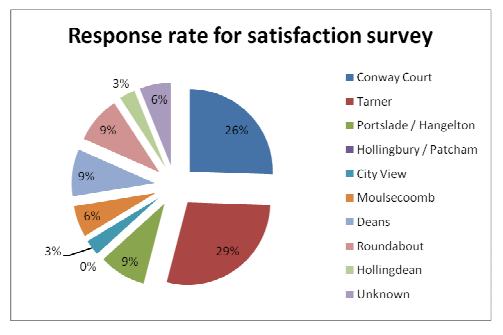
The best rate of return was from Tarner Children’s Centre (9 of 10), thanks to Jane Parkinson (service manager) at Tarner for facilitating the distribution, collection and return of the survey. It was disappointing that there were no responses from Hollingbury & Patcham.
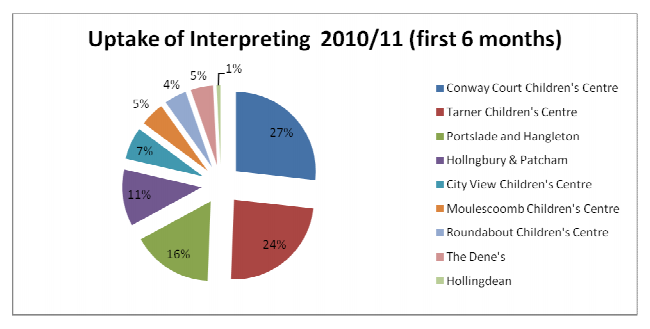
The return rate per Children’s Centre was comparable to the rate of interpreting uptake per Children’s Centre especially for the heaviest users. This provided an additional layer of validity to the results.
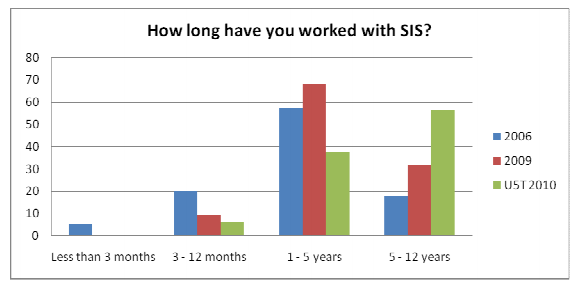
There was strong evidence of a long term collaborative partnership with U5T workers, particularly in comparison to previous surveys. In addition, more than 50% of respondents had used SIS more than 20 times. The longevity and intensity of service use means respondents have a long history of access to SIS and experience of our services to draw on when answering the questions.
Nearly all of the respondents had found out about SIS from colleagues and 100% would recommend SIS to other colleagues which show fantastic support for the service.
Questions 5 – 9 are all questions posed using a Leichart Scale to grade degrees of satisfaction. Respondents are asked to state how strongly they agree / disagree with statements on a scale of 1 – 5.
The results showed an extremely high level of satisfaction with close to 100% of respondents either strongly agreeing or agreeing with the statements.
We were extremely pleased to note there were no statement to which respondents actively disagreed or strongly disagreed. This is the first Service Provider survey for which this has happened.
SIS had set some challenging and stretching targets for levels of satisfaction.
With comparison to the surveys of 2006 and 2009 –
- To equal or better the % of respondents who agree or strongly agree with the statements
- To reverse the previous trend by increasing the % of respondents who strongly agree
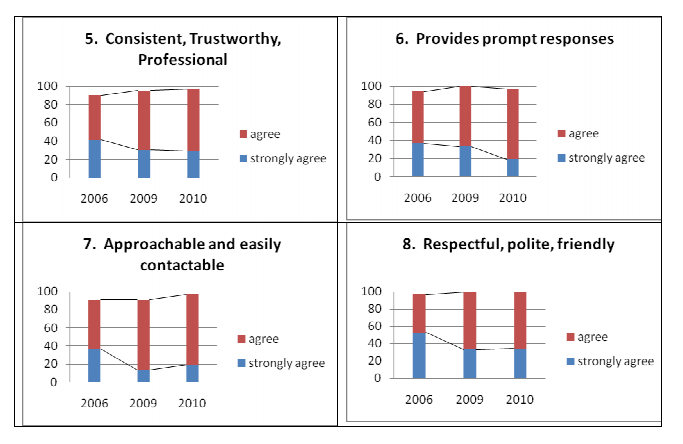
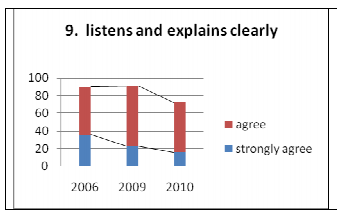
SIS met it’s targets for questions 5, 7 and 8. The level of respondents who strongly agreed has improved on the 2009 figures but has not returned to the levels of 2006. It has been suggested that the generally lower levels for strongly agree may be reflective of the current “national mood” in view of the recession and credit crunch.
We were particularly pleased to meet our targets for Qu 7 – SIS is approachable and easily contactable. This has been our weakest area in the past resulting in various measures being implemented to combat the issue. They have finally come to fruition.
We missed our targets in two key areas of service delivery;
Qu 6 – SIS provides prompt responses to my needs
In 2009, 100% of respondents agreed or strongly agreed making this a difficult target to meet. Continued growth of the service coupled with a period of staff shortages in the summer of 2010 may have meant we were less able to respond promptly.
SIS has challenging and stretching targets for response times and quality assurance. We publish the quarterly monitoring on our website and implement any improvements or changes required as a result of the evaluation (summary of relevant data below).
| 2009-10 targets |
3rd Qu. |
4th Qu. |
2010-11 targets |
1st Qu. |
2nd Qu. |
|
| Acknowledge SP referral in 2 days | 85% | 91% | 48% | 88% | 88% | 90% |
| Interpreting requests met | 95% | 97% | 95% | 96% | 97% | 96% |
The data shows a significant dip in our responses to Service Provider referals in the period Jan – Mar 2010 but we met our target in all other quarters. It is also reassuring to see that we were able to meet 96% of interpreting requests indicating that any dis-satisfaction focussed on the prompt response rather than meeting need.
We have been unable to produce accurate and meaningful monitoring data for the time frame within which we confirm the attendance of an interpreter at a session. This is due to the difficulty in corrolating the different notice periods received from Service Providers with the notice period of reconfirmation. This may be the area in which U5T practitioners felt we were less prompt. We hope that improvements to our database will enable us to monitor this data in future.
Qu 9 – SIS listens to me and explains its services clearly
We were concerned to note a 19% increase in respondents who neither agreed nor disagreed with the statement. These respondents (9/32) were asked for further clarification. The replies (2/9) indicated that there wasn’t any dis-satisfaction but simply an inability to answer the statement through lack of contact or opportunity.
e.g. Hi. The reason I guess I put neither agree or disagree is because although I’ve booked an interpreter I’ve done it through fax so don’t speak to anyone prior to the visit. When I meet with the interpreter I usually suggest how I’d like the interpreting to work. Sorry, I don’t give them chance maybe to explain anything!!!!
Only 2 respondents provided further clarification so, we also looked at the answers to related questions in the survey to try and tease out more information
- In Question 10 (see below) they found speaking a Co-ordinator slightly more important than the average (3.4 as apposed to 3.9) but there were still three more important factors
- In Question 14 the degree to which they found our guidelines useful was the same as for the group as a whole (please see below for more details).
We would like to visit U5Ts to report back on the survey results, to disseminate our guidelines and to generally `listen and explain` a little further.
Question 10 asked respondent to rate what was most or least important to them with 1 being the most important and 7 the least.
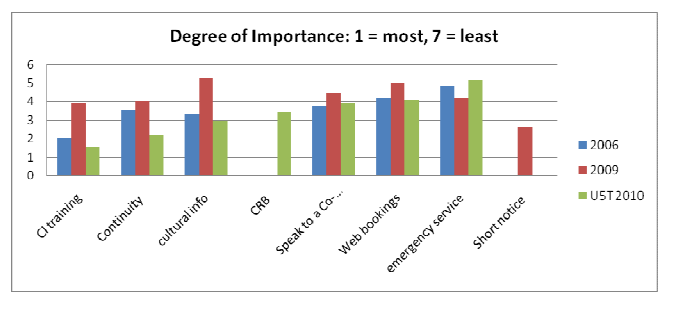
It was clear that Health Visitors had a strong agreement about the most important factors – training, continuity, cultural information, and CRB checks. This was backed up by the additional comments provided (examples below).
The community interpreter is trained to an accredited level
- Having used family/friends as “interpreters” in the past I feel the training SIS interpreters undergo is vital re communication ….. Family/friends tend to answer for the client sometimes.
- Accredited level; accurate and sensitive interpreting skills are essential to deliver a effective HV service.
- It is important that we are able to rely on the interpreter to relay information correctly and confidentially and that the clients trust in the service and will be receptive to further visits.
85% of SIS interpreting sessions in the past 18 months were delivered by accredited trained Community Interpreters.
I have continuity of the same community interpreter for the same patient
- The clients we use SIS for are often vulnerable and traumatised so the continuity of one interpreter is valued.
- Some families have complex needs and a parent needs to have a good rapport with the interpreter.
- For reasons of sensitive personal information being discussed it is reassuring for the family if the same interpreters can be used on subsequent visits.
SIS’s Allocations Policy states
“SIS endeavours to provide continuity for clients with the aim of providing a holistic service.”
The community interpreter can provide appropriate cultural information
- Additional information provided by the interpreter regarding lifestyles and practices is always helpful.
- Good to have cultural information in order to assess a family’s needs and to understand their situation.
- Cultural information; important for HV to know as HV plan can be tailored to client’s needs.
One of the unique aspects of the Community Interpreting model (in contrast to the Public Service Interpreting Model) is the ability for the community interpreters to use intervention skills to present factual cultural information to enable the SP to steer away from action and advice that may be culturally inappropriate or insensitive.
The community interpreter has enhanced CRB clearance
Although the U5Ts rated this as the 4th most important factor, the two comments about CRB clearance were from opposite standpoints.
- The interpreter has no reason, in our setting, to be left alone with the child / baby.
- As it is a children’s service and often sensitive personal information is discussed, it is extremely important that any interpreters are CRB checked.
SIS has long acknowledged the need for CRB clearance for all it’s linguists and from January 2011 ALL linguists will have to have enhanced CRB clearance which is less than 3 years old and specific checks on their appropriacy to work with children and vulnerable adults.
Question 12 asked if using a telephone interpreter instead of a face-to-face interpreter could produce the same outcome for the client. U5T practitioners overwhelming answered NO.
However, the additional comments indicate that at least half of the respondents may not have a full understanding of telephone interpreting; the comments suggest that respondents thought telephone interpreting would mean Health Visitors would not visit the clients in their home but try to conduct the entire session by phone from their office.
- Home visiting service is at the core of health visiting
- Too impersonal and not able to observe body language.
- Much easier to develop a conversation and demonstrate an empathetic manner when face to face.
- I have to ask some very personal and sometimes difficult questions and I think their gestures and facial expression can be very important in conveying meaning.
However, when these comments are looked in the wider context, it is clear that a face-to-face interpreter would be preferable and far more effective in a Health Visiting environment than a telephone interpreter; much body language and facial expression is cultural specific, and providing cultural information was considered a very important factor in using a community interpreter.
Question 13 asked to what extent would you agree/disagree that SIS makes an essential contribution to enabling Under 5 team to deliver national targets for early years?
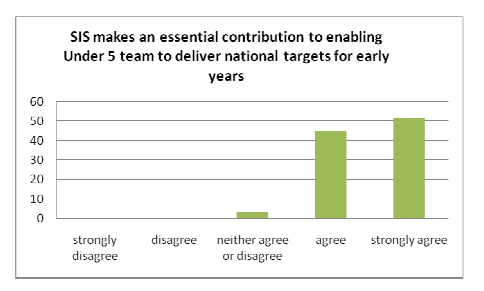
This is a fantastic indictment of the work we are doing, backed up by the further comments e.g.
- I would be unable to give as much information as I would to someone who speaks English and therefore they would not be getting the same information or standard of care that the British local population would get to attempt to achieve targets.
- We would not be able to communicate with our clients putting their children at greater risk and disadvantage within the community.
- It enables professionals to describe activities in the local community so that clients can access these to benefit their child’s social, emotional and physical development
- It helps to identify the family’s needs and discuss services and resources available to support them and reduce social isolation
Question 14 asked how useful U5T professionals had found the SIS Guidelines for working with Community Interpreters.
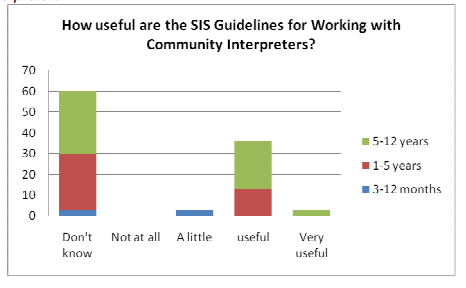
It is worrying that over half the replies stated “don’t know” to this question, implying that they had never seen these essential guidelines. This is particularly concerning when so many of the U5T respondents had been working with SIS for a long time.
All of these individuals have now been sent the guidelines by e mail (61% expressed a preference to receive the guidelines in writing) but it is essential that we formulate a strategy to ensure that users of the service are fully informed about how to work with interpreters as this was a weakness identify in question 9 (see above).
It is part of the Community Interpreter’s role to give information about how they work, their boundaries and limitations at every session (details in the Community Interpreters Code of Practice). It must be assumed that this has been a fairly effective way of delivering information however the information provided by the interpreters is quite basic and is meant to be only a reminder. It would be preferable for Service Providers to have knowledge about, access to, and have read the full guidelines.
The question asked for any further comments or suggestions
- Asking an interpreter to phone a client with queries following a visit would be very useful
This would fall outside the role boundaries of a Community Interpreter unless the U5T professional was using telephone interpreting and was also on the phone. If there was no U5T professional involvement, it would entail the interpreter giving information and/or provide advocacy to the client.
SIS is currently involved in the delivery of a Health Advocacy Pilot running for 12 months in East Sussex, the results of this pilot may be able to inform a similar service in Brighton & Hove.
- Would find it useful if SIS could help to make appointment with non-English speaking clients
This has frequently been identified as a desirable additional service that SIS could offer. SIS Community Interpreters are all linguists and are not office based making the logistics of offering such an appointment making service very difficult. In addition, it may once again push interpreters out of their role into that of an advocate.
- Feel it is very important to have female interpreters at visits during 1st 3 months after birth.
SIS co-ordinators do not always have information about particular patient’s needs or situation. We rely on practitioners to make their needs clear on the booking form. Advice on completing the booking form is found in SIS’s Guidelines for Working with Community Interpreters which we hope all Health Visitors will have been able to read now.
In addition, SIS’s allocation policy states
“In the first instance SIS is required to approach a level 3 CI. In the absence of a gender match we will send a level 3 CI of the other gender, attempting to seek the client’s permission where the nature of the session involves sensitive social care and health issues.”
- I feel it’s worth commenting on the statement “I can use the SIS website to book an interpreter” this actually is not correct for those of us who work for Southdowns health as the trust does not have a secure link with you therefore it would be unacceptable to put client details in a web application – it is trust policy that we are only send e mails internally or to e mail addresses ending in gov.uk.
We are currently working on creating a more secure e mail communication link for web bookings.
- I wonder if you do translations as well as interpreting
SIS does provide a translation service as well as interpreting. However, translation is not core funded in the same way as interpreting. We would charge for translation on a job by job basis, raising an invoice to Southdowns Health, we therefore need agreement to meet the costs before going ahead with the translation.
